
After completing the Time Tangled island, I tried the Virus Hunter island. Although the premise of the game was similar, it was noticeably more difficult. The Time Tangled island was a level one difficulty, and the Virus Hunter was a level three difficulty, which showed in the game. The riddles were harder to solve than in the Time Tangled island, and the objectives were not as straightforward. In addition, the Virus Hunter island involved more exploration, as I had to click on seemingly unimportant objects to uncover clues. For example, I found crumpled up letters in a trash can that revealed to me the next part of the mission. I found myself becoming mildly frustrated playing the Virus Hunter island, so I wonder if junior high or high school students would be frustrated as well or if they would be motivated to take on the challenge.
Whereas the Time Tangled island was more history-oriented, the Virus Hunter island could be applied in a science context. The storyline is that there is a character on the island that is infected with a deadly virus. I have to figure out who has the virus and how to cure it in order to save the world from “complete global extinction,” as seen in Figure 1.

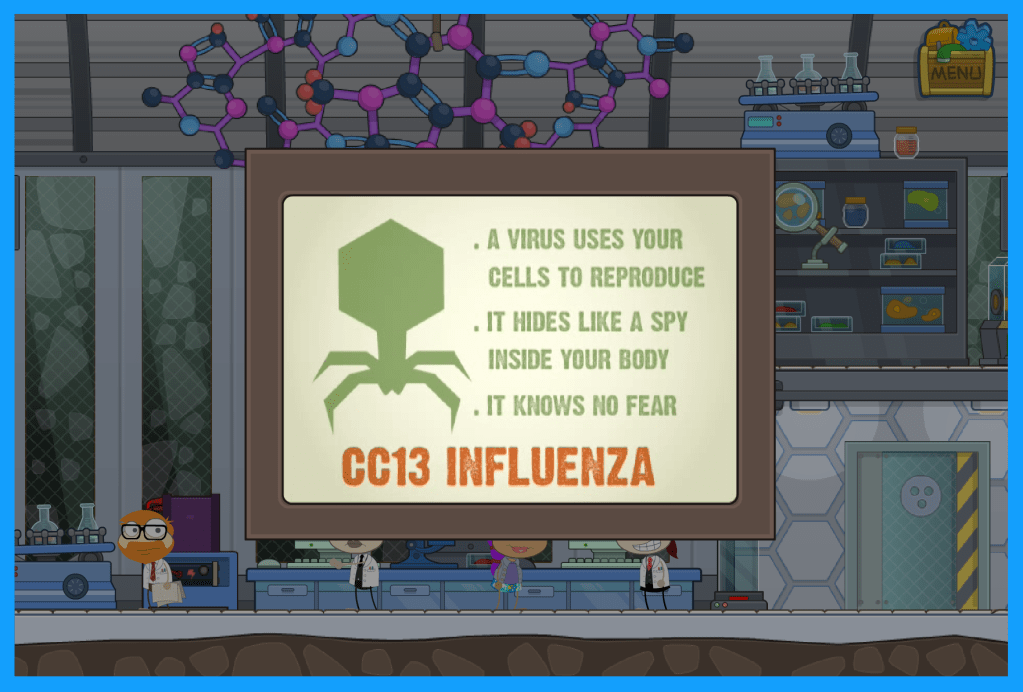
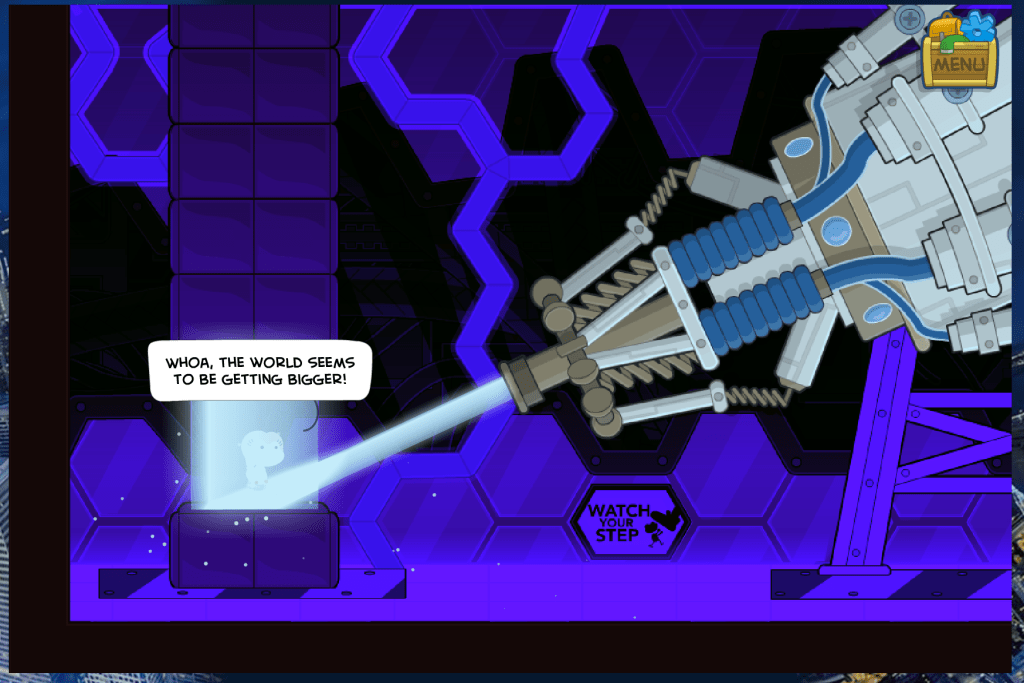
The game also incorporated some basic level information about anatomy and how viruses work, as illustrated by Figures 2 and 3. In addition, there was an interesting part of the game where my character was shrunk down so that she could an infected person’s body to fight the virus, as shown in Figures 4 and 5. These aspects of the game provide students with a unique, hands-on approach to anatomy. Furthermore, I thought this island reflected the fish tank learning principle, as mentioned in Gee’s article. While anatomy in relation to viruses is a complex topic, this island simplifies it down to more basic concepts, allowing for a point of entry for students.
I believe that the presence of the fish tank principle within the game enables it to be used as either an introduction to a science lesson or a conclusion. If used as an introduction, this island would allow students to encounter the content material for the first time in an engaging yet simple way, as to not overwhelm students. On the other hand, the teacher could implement the game at the end of the lesson, in which it would act as a basic review of concepts to solidify student learning.

The Virus Hunter island most obviously fits into a science context, so I tried to apply it to other disciplines as well. A teacher could incorporate this island into a history lesson about current events, possibly relating it to the outbreak of the Coronavirus and its implications. I also extrapolated that this island could be used in an ELA context if the class is reading the apocalyptic literature genre. Although this book is not typically taught in schools, I immediately thought of Richard Preston’s Hot Zone, which is a nonfiction book about the incidents surrounding infectious viruses, such as the ebola virus. Furthermore, this island could be used as supplemental material for students’ reading comprehension.
Poptropica is not your typical “educational game,” which I initially thought would be a hindrance to effectively implementing it into a classroom setting. However, I believe that the game’s open-endedness actually creates multiple possibilities of integrating it into the curriculum. The potential application of Poptropica in many different contexts reflects Shapiro’s point that games should allow players to engage with knowledge in interdisciplinary ways (2014). I believe that the immersive nature of Poptropica allows students to understand complex situations, like a virus outbreak, from various angles.

In my initial blog post, I thought that Poptropica was a crossover creative game-based platform, meaning it could be used as a short-form or long-form game. However, after playing for awhile, I believe the game would be more effective as a short-form game. Due to the games’ various distractions, which I discussed in my last blog post, I would argue that students could better maintain their focus on the games’ missions if playing for short periods of times. Furthermore, the islands do not provide enough depth to be used as a long-form game throughout the duration of an entire unit, as I could complete an island in one or two sittings. Rather than being used as an integral tool to teach a specific skill or knowledge, I think that Poptropica is better used in small doses to enhance learning experiences for students.
Reflecting on the game as a whole, I undoubtedly see more educational value in it now than when I mindlessly played as a teenager. It was fun to see an old game through a new perspective! However, I think this reality speaks to the importance of a teacher. Without a teacher’s guidance, students could easily become swept up in the fun and excitement of the game without reflecting on its connections to the class material. While Poptropica has some limitations, I believe that the game makers ultimately succeeded in creating a game that is both fun and educational, and I can envision myself utilizing this game in the classroom.
 Josie's ED 386 Blog