
I chose to play Poptropica for the video game exploration because I played it as a teenager for fun—never in school but simply on my own time at home. As a child, I never considered this game to be “educational,” so I am curious to explore it through the lens of a teacher.
(Re)learning to play the game
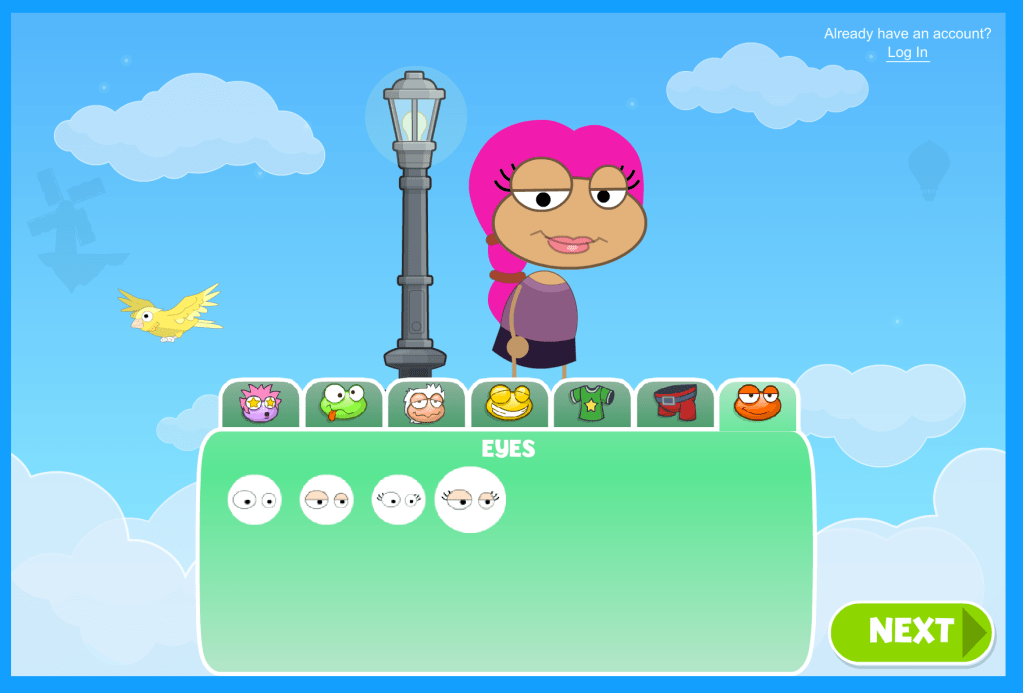
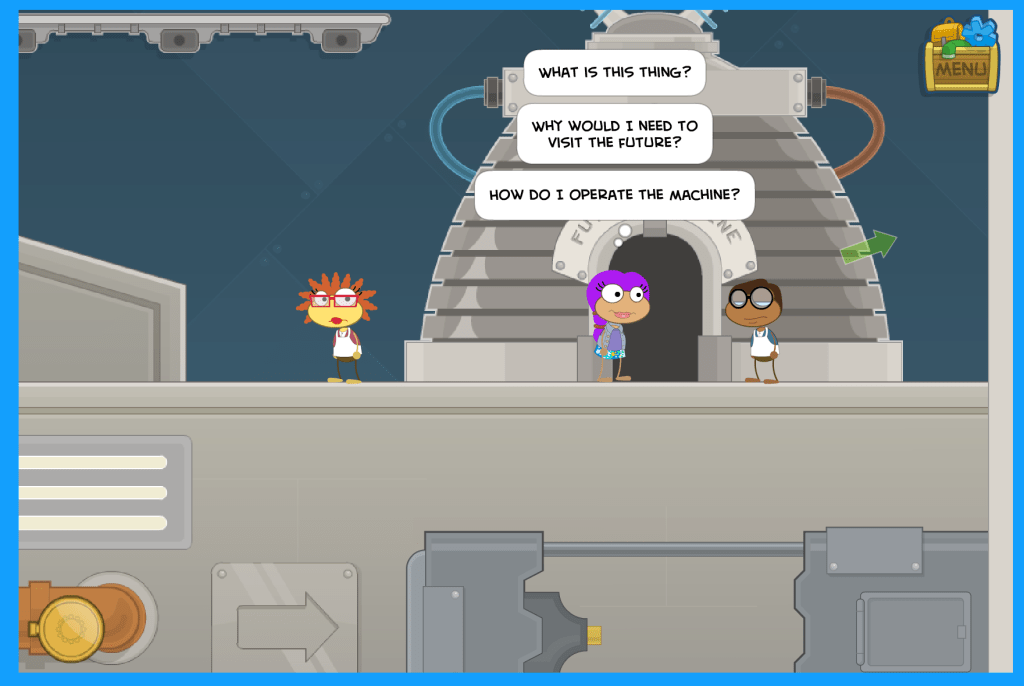
Poptropica is an exploratory game where players can choose from a variety of islands; players must complete a series of missions within the island to accomplish an overarching objective. Before diving in, I created my own avatar, which was a fun way to get involved in the game from the start. I chose the island called “Time Tangled.” The objective is to return various objects that have been scattered throughout space and time, due to a malfunctioning time machine, to their rightful place in history.
The game is fairly difficult, and I have not yet completed the island I chose. I have learned that successfully completing an island is definitely a time investment. While the game may become redundant or boring for older students, I think it could be effectively implemented in a 7th, 8th, or 9th grade classroom, as it has many affordances.
Poptropica affords students the ability to hone a variety of skills, such as critical thinking, problem solving, pattern recognition, organization, etc., which are important across all disciplines. For example, in the “Time Tangled” island, I have had to keep track of numerous clues and objects from various characters to work toward the objective of restoring history. I even made myself a list:
- Oracle needs gold vase
- Vikings need hammer amulet
- Da Vinci needs his notebook
- Merchant needs salt rocks
- Aztec king needs piece of sun stone
- Construction worker needs stone bowl

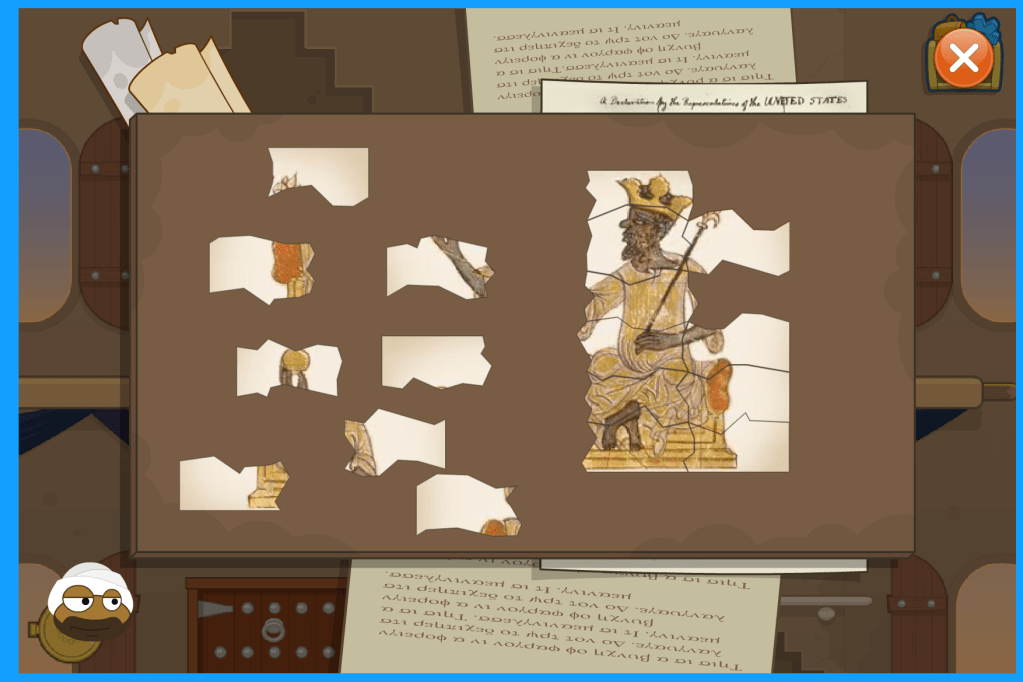
In addition to these skills being embedded within the game, there are also brief mini games that focus on them specifically, such as assembling a puzzle or solving a series of math problems.
While playing the game, I also noticed that it forces the players to be creative, curious, and think outside the box. For example, I had to converse with every character I encountered because I never knew who would give me valuable information. In addition, I had to explore the various settings in depth because there were often hidden clues. Although there are certain missions to accomplish, players can use a variety of strategies and methods to reach the objective. In other words, there is not one defined path that players must take to accomplish the goals of the game.
I was also surprised by the amount of content information that is embedded in the game, which was another affordance. This specific “Time Tangled” island would be particularly relevant for a history classroom. For example, this island not only takes place in numerous historical time periods but also references a variety of historical events, such as the signing of the Declaration of Independence and the construction of the Great Wall of China. In addition, many of the key characters in this island are real historical figures, such as Leonardo da Vinci, Benjamin Franklin, and Great King Mansa Musa. I had never even heard of the last figure who I discovered upon further research was a sultan of the West African Islamic Mali Empire, as shown in figure three.
Incorporating the game into the classroom
Due to its various affordances, I would classify this game as a crossover creative game-based platform, meaning that it could function as a short-form or long-form game, according to chapter three of Mindshifts. Utilizing it as a short-form game, teachers could have their students play Poptropica for a class period or two at the culmination of a world history lesson. In this case, the game would enrich students’ understanding of the historical periods, places, events, and characters they learned about in class. Furthermore, I could envision students making a detailed timeline for based on the “time traveling compass” within the game, which nicely lays out historical time periods and places.

Utilizing it as a long-form game, teachers could also incorporate this island multiple times within a series of lessons. By asking students to stop playing the game when they complete a specific objective, the teacher could use the game as a supplement for specific history lessons. The game would then become an integral part of the overarching unit.
While these are two examples of how to incorporate the game in the classroom, I realized that I have only explored one island. There are many different islands, such as 24 Carrot, Mythology, Mission Atlantis, Arabian Nights, Virus Hunter, etc. I look forward to exploring the other islands within Poptropica, which will help me formulate ideas about how to best utilize this game for my students, hopefully within my ELA discipline.

Even when brainstorming ideas, I found it difficult to develop methods of incorporating the game into lesson plans. This game is not your typical “educational game,” and it is unlike the drill-and-practice games that I was so used to playing in school. As I mentioned earlier, I played this game purely for entertainment as a teen. Therefore, figuring out how to bring Poptropica into the classroom was not intuitive. As a result, I understand why many educators are hesitant to incorporate video games in their daily routines. Simply brainstorming ideas for a hypothetical classroom took some critical thinking, creativity, and time, so I can imagine the difficulty of following the same process but for a real classroom setting. Although integrating video games into the classroom may require some extra effort, I do believe that the ultimate pay off for students is worth it.
The fact that I never thought about this game as “educational” when playing it as a child speaks to its value. As mentioned in chapter three of Mindshifts, video games should both excite and challenge our students. In other words, these video games should not be traditional worksheets in disguise. I believe that many students hold the misconception that educational value and fun are mutually exclusive. Fortunately, I also believe video games like Poptropica are tools that we, as educators, can use to dismantle this stereotype.
 Josie's ED 386 Blog